|
Welcome
to the Neurosurgical
Medical Clinic.
Our surgeons and nurses provide neurosurgical care in many
of the major hospitals in San Diego, California. Our surgeons
and staff provide individual and conscientious treatment using
the most effective and modern techniques available in the
world. We hope our web page can bring you valuable
information about our practice...the neurological disorders we
treat and the procedures we perform.
|
A
Forest of Neurons: IBM and the Ecole Polytechnique
Fédérale de Lausanne ..... A dye is injected into each brain
neuron and then developed in order to reveal its morphology.
This image shows a minute fraction of the cells and
connections within the interconections of the brain's
neocortex.
|
|
|
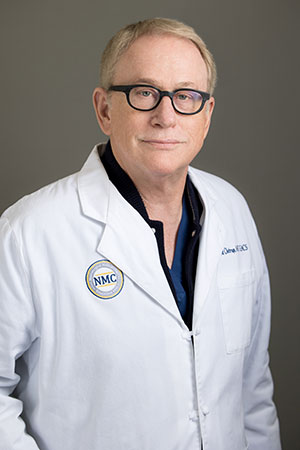
Dr.s
Altenau and Ostrup in the news. . .
Watch Sharp's TV Documentary
New episode of award-winning documentary series on air
now
Watch Sharp's compelling half-hour
documentary featuring real-life stories of advanced clinical
care. Produced on location at Sharp hospitals and medical
facilities, the documentary captures stories of hope told
entirely in the words of patients, their families and
caregivers.
In the latest episode of Sharp's award-winning
documentary series, "Stories of The Sharp
Experience," rehab specialists strive to help a young
motorcycle racer walk again, high-tech surgery is a war
veteran’s best chance to return to police work, and a
young father battles to overcome a recurring brain tumor.
These powerful stories demonstrate the Sharp
Experience Sharp’s journey to make health care
better.
|
|
|
Comprehensive
CyberKnife radiosurgery begins. . . |
The
NMC
is participating in the latest and most up-to-date CyberKnife
program in San Diego County adding to our successful
radiosurgical program at the San Diego Gamma Knife Center in
La Jolla. The CyberKnife is a robotic linear accelerator,
generating precisely aimed x-ray beams. Powerful computer
treatment planning allows curative doses of radiation to be
delivered in one treatment session to malignant and benign
tumors throughout the entire body. Gamma Knife therapy
is limited to tumors within the head and remains
the Gold Standard for intracranial radiosurgical
therapy.
With
the power of this new radiosurgical
device we will develop a comprehensive program for the
treatment of metastatic tumors of the spine including
radiosurgery, reconstructive surgery and rehabilitation
|
|
|
|
|
|
Gamma
Knife Program featured in MD News. . .
Our
radiosurgical program at the San Diego Gamma Knife Center was
recently profiled in MD News. The article outlined the program
developments and advantages. We will participate in a Cyber
Knife project in Vista which will
begin
treating patients in the summer of 2007. This will extend our
ability to treat benign and malignant tumors of the spine and
peripheral nerves with radiosurgery, just as we have treated
intracranial disorders with the Gamma Knife. Over 2700
patients have been treated with Gamma Knife radiosurgery since
the center started in October 1994.
The
latest technology in radiosurgery, the Leksell Gamma Knife 4C,
was installed in January at the San Diego
Gamma
Knife Center. This new machine incorporates sophisticated
software technology to develop single session radiation
treatments for a vast variety of benign and malignant brain
tumors. Painful trigeminal neuralgia
can also be treated in a entirely non-invasive single
treatment . The treatment allows radiation to be confined to
the tumor and avoids excessive radiation of the nearby brain.
Since the radiation is conformal, higher doses may safely be
used safely, with increased effectiveness when compared to
conventional radiation therapy.
Click here for information
about gamma knife treatments.
|
|
|
X
Stop Interspinous Process Decompression System (IPD) now
performed by NMC surgeons. . .

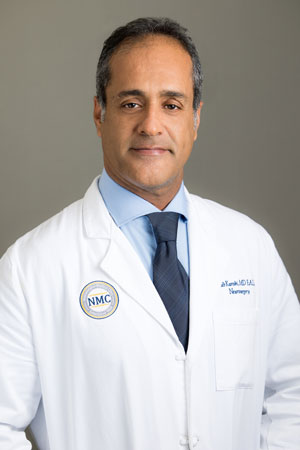
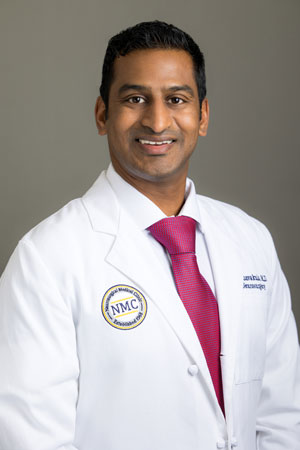
Dr.s
Kureshi , Zubay and Greenwald are introducing the X-Stop spinal device to
San Diego. This is a minimally invasive procedure, performed
with local anesthesia for the treatment of spinal stenosis in
selected patients with lumbar spinal stenosis. Spinal stenosis
is narrowing of the spinal canal in the low back due to
arthritis. This may caused leg pain, numbness and weakness
which is relieved by sitting. The X-Stop system is
indicated in patients over 50 years old with symptomatic
stenosis which is relieved by flexion of their low back
(for example, sitting or bending forward). Usually these are
individuals who for over-all health reasons would not
tolerate a standard decompressive laminectomy for lumbar
stenosis.
|
|
| New
CD describes our endoscopic procedure for sweaty hands... Excessive
sweating of the hands, feet and underarms is a common problem.
Sometimes even the face and scalp are involved. At extremes,
this may become not only be embarrassing but become a social,
psychological and professional disability.
We
have a successful program of surgical treatment for
hyperhidrosis, using
endoscopic thoracic sympathectomy. Same day surgery can cure
excessive sweating in the hands, underarms and face in the
vast majority of patients. This procedure is performed as an
out-patient procedure at several of our hospitals.
Pathological facial blushing and reflex sympathetic dystrophy also
respond this same-day treatment
A
CD is
available through our office. The CD outlines the experience
of suffering from excessively sweaty hands from a patient's
point of view and scenes from the operation itself. Contact Glory
Hammond for copies...
click here for
information about endoscopic sympathectomy
|
|
|
Deep
brain stimulation for Parkinson's Disease and tremor....160
patients treated by 2008. . .
We
have treated more than 160 patients with PD and essential tremor
with placement of deep brain stimulators at Scripps Memorial Hospital in La
Jolla with considerable success. click
here for information about our movement disorder program.
|
|
|
A
paper describing a promising new treatment for cluster headache. . . delivered
at the
International Stereotactic and Radiosurgical Society for the June 2007 meeting
in San Franisco.
Cluster
headache (CH) is a severe and disabling periodic pain disorder. Short periods
of periorbital pain are accompanied by parasympathetic effects: lacrimation,
conjunctival injection, nasal congestion, etc. Medical treatment of episodic
and chronic CH is usually effective, but a small group of patients are
refractory to medical treatment. The somatic and autonomic manifestations of CH
have challenged the imaginations of surgeons. We report our initial experience
treating both the trigeminal nerve and sphenopalatine ganglion (SPG) for CH.
In the past, surgical lesions
of the trigeminal nerve (TN) have produced initial relief in more than
one-half of patients. Gamma Knife radiosurgical
lesions of the TN have produced short-lived pain relief and perhaps
increased toxicity. In this pilot study we added the sphenopalatine ganglion
as an additional target in an effort to extend the degree and length of pain
relief. Over an eight year period we carried out 12 Gamma Knife
radiosurgical treatments in 7 patients, treating only the TN or later both
the TN and SPG contemporaneously. One patient with 3 treatments to the TN
enjoyed immediate and complete relief for 5, 22, and 25 months. Four of 5
patients with radiation of both the TN and SPG experienced pain relief for 8
and 30 months, or are continuing to enjoy pain relief
7,
18, and 22 months after treatment or re-treatment at the last follow-up.
Most patients reported facial paresthesias following radiation. No profound
numbness or deafferentation pain was experienced. These results, in some
respects, reflect the morbidity and pain relief experience of Gamma Knife
radiosurgery for classical trigeminal neuralgia. The addition of the SPG as
a target may prove to be valuable and has not increased the morbidity of
treatment.
|
|